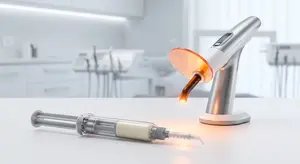
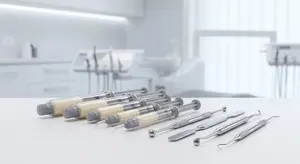
Class II restorations require more than replacing missing tooth structure. Restoring a proximal surface means rebuilding contact points, maintaining marginal integrity, and selecting a material that matches the functional demands of the tooth. While cavity classification defines the location of the restoration, material selection influences handling, adaptation, finishing, and long-term clinical performance. Understanding how these factors work together helps clinicians choose restorative materials based on the requirements of each case rather than following the same approach for every Class II restoration.
Class II fillings are direct restorations placed in cavities that involve the proximal surfaces of posterior teeth, including premolars and molars. This classification is based on G.V. Black's cavity classification system, which groups restorations according to the surfaces affected by caries, fracture, or replacement of an existing restoration.
Unlike Class I restorations that are limited to pits and fissures, a Class II restoration extends into the mesial or distal surface. Restoring these areas requires more than simply filling the cavity. The clinician must recreate proximal contact, establish proper contour, protect the gingival margin, and achieve a comfortable, functional occlusion after placement.
Because of these additional restorative requirements, Class II procedures often involve matrix systems, wedges, sectional rings, and careful finishing to achieve predictable clinical results.
Not every Class II filling presents the same restorative challenge. The preparation design, remaining tooth structure, and location of the gingival margin all influence treatment planning and material selection.
For example, a small proximal lesion with intact cusps may require a different restorative approach than a large MOD (mesial-occlusal-distal) preparation involving weakened tooth structure. Similarly, a cavity with margins located entirely in enamel presents different bonding conditions than one extending onto root dentin or cementum.
These differences explain why clinicians often evaluate the clinical situation before selecting the material. The cavity classification identifies where the lesion is located, but it does not determine which restorative material should be used.
Instead, material selection should consider factors such as:
Reviewing these factors before beginning the restoration helps match the material to the clinical situation rather than adapting the procedure to a single restorative product.
A successful Class II restoration depends on more than cavity preparation and placement technique. The restorative material should support the clinical objectives of the case while providing handling characteristics that suit the clinician's preferred workflow.
Some clinicians prefer a universal composite that can be used across a wide range of anterior and posterior restorations. Others choose a dedicated posterior composite when they want a firmer consistency for shaping proximal contacts and occlusal anatomy. In deeper preparations, a glass-ionomer liner or base may also be considered before the final composite restoration when clinically appropriate.
Each category serves a different purpose. Selecting the right combination helps create a restorative workflow that supports both efficiency and predictable clinical outcomes.
For many practices, a dental composite serves as the primary restorative material for Class II procedures. A universal composite offers flexibility across different cavity sizes while allowing clinicians to maintain a consistent restorative workflow.
Our ProFil composite is a light-cured, radiopaque microhybrid composite designed for use in both anterior and posterior restorations. Its non-sticky formula, polishability, low polymerization shrinkage, strength, and wear resistance support handling, sculpting, and finishing across a broad range of restorative cases, including many Class II restorations. ProFil is available in 14 shades and features a chameleon effect that supports shade blending.
Rather than limiting the practice to multiple composites for everyday procedures, a universal composite can provide a reliable foundation, with additional restorative materials introduced only when they offer a clear clinical advantage.
Although many Class II fillings can be completed with a universal composite, some clinicians prefer a restorative material developed specifically for posterior teeth. The difference is not the cavity classification itself but the handling characteristics the clinician wants during placement.
Large posterior restorations often require careful development of proximal contacts and occlusal anatomy. A composite with a firmer, more packable consistency may provide greater control while shaping these features, particularly when restoring molars exposed to higher occlusal forces.
Our ProFil Posterior is a visible-light-activated, radiopaque restorative composite designed specifically for posterior direct and indirect restorations. According to the product information, it combines Bis-GMA, TEGDMA, and UDMA resins and offers wear resistance, strength, low polymerization shrinkage, and handling characteristics that support marginal adaptation and interproximal contact. Its packable consistency supports posterior restorative procedures, and it is available in six shades.
Choosing a posterior composite does not replace the need for a universal composite. Instead, it gives clinicians another option when the clinical case or their preferred placement technique calls for a material with different handling properties.
Not every Class II preparation is managed with composite alone. In deeper preparations, particularly where dentin protection is a consideration, some clinicians incorporate a glass-ionomer liner or base before placing the final composite restoration.
This approach depends on the clinical situation and treatment plan rather than the cavity classification itself. Factors such as remaining dentin thickness, preparation depth, and the location of the gingival margin all influence whether a liner or base is appropriate.
Our ProBase is a light-cured reinforced glass-ionomer cement designed for use as a liner/base material. It can be used beneath composites and other restorative materials to help isolate and protect dentin when clinically indicated.
Because every preparation is different, the decision to use a liner or base should follow the clinical requirements of the case and the product's instructions for use.
Some deep proximal restorations may benefit from the sandwich technique, where a glass-ionomer material is placed at the base of the preparation and covered with a composite restoration.
The technique is generally considered when the clinical situation supports combining the properties of two restorative materials rather than relying on a single material throughout the restoration. The glass ionomer forms the base, while the composite restores the occlusal anatomy and esthetics.
Within the Silmet restorative range, ProGlass Nine is indicated as an intermediate restorative and sandwich material for heavy stress-bearing Class I and II cavities. ProFil, a universal microhybrid composite for anterior and posterior restorations, can serve as the composite component when the selected treatment approach calls for a glass ionomer and composite combination.
The sandwich technique is not required for every Class II restoration, but it remains a useful option in selected clinical situations where the restorative objectives support its use.
Practices looking to refine their restorative system for Class II procedures may benefit from evaluating their clinical workflow to determine the combination of composite and glass-ionomer materials that best fits the restorations they perform most often.
Even with careful treatment planning, Class II fillings present challenges not typically seen in other direct restorations. Many of these relate to restoration design and clinical technique, but material selection can also influence how efficiently the procedure is completed.
Achieving Predictable Proximal Contacts
One of the most common objectives in a Class II restoration is recreating a stable proximal contact. Matrix selection, wedging, and placement techniques all play important roles, but the handling characteristics of the restorative material also affect how easily the anatomy can be developed.
Some clinicians prefer a universal composite for its versatility across different restorative procedures, while others choose a dedicated posterior composite when they want a more packable consistency for shaping proximal contours.
Adapting to Deep or Irregular Preparations
As preparation depth and complexity increase, adaptation may become more technique-sensitive. In selected cases, a glass-ionomer liner or base may be placed before the final composite restoration when the treatment plan supports this approach.
Using each material according to its intended indication allows the restoration to be built in stages rather than expecting one restorative material to address every clinical requirement.
Balancing Esthetics and Function
Posterior restorations are expected to restore function while blending naturally with the surrounding dentition. Shade selection, contour, surface texture, and polish all contribute to the final result.
A dental composite intended for routine restorative procedures provides flexibility across many clinical situations, while posterior-specific composites may offer handling characteristics preferred for larger occlusal restorations.
Selecting Materials for Long-Term Workflow
Many practices gradually expand their restorative inventory as treatment patterns evolve. Instead of replacing existing materials, they add products that address specific clinical requirements.
For example, a universal composite may remain the primary restorative material for everyday procedures, while a posterior composite or light-cured glass-ionomer liner/base is introduced to support particular restorative techniques. Building the system this way helps avoid unnecessary duplication while giving clinicians materials designed for different indications.
Clinical Situation
Material Category
Silmet Solution
Routine Class II restorations in anterior and posterior workflow
Universal composite
ProFil
Posterior restorations where a packable handling profile is preferred
Posterior composite
ProFil Posterior
Deep preparations requiring a liner/base before composite placement, when clinically indicated
Light-cured glass-ionomer liner/base
ProBase
Restorations using the sandwich technique
Glass ionomer + universal composite
ProGlass Nine + ProFil
There is no single material that fits every Class II restoration. The most effective approach is to build a restorative system that reflects the procedures your practice performs most frequently.
For many clinicians, a universal composite provides the foundation for everyday restorative work. A posterior composite may be added when greater sculpting control is preferred for larger posterior restorations. Where clinically appropriate, a glass-ionomer liner or base, or the sandwich technique, can further expand treatment options for deeper preparations.
Our restorative portfolio is designed around these different clinical roles. ProFil supports routine direct restorations across a wide range of anterior and posterior applications. ProFil Posterior provides a dedicated option for posterior restorative procedures. ProBase is intended for liner/base applications beneath composite and other restorative materials, while ProGlass Nine can be used as an intermediate restorative and sandwich material for indicated Class I and II cavities.
Selecting materials according to their intended use helps create a more efficient restorative workflow while giving clinicians flexibility to manage different Class II cases.
Can the same composite be used for every Class II restoration?
A universal composite can be suitable for many Class II fillings, but it may not be the preferred choice for every clinical situation. Factors such as cavity size, remaining tooth structure, handling preference, and restorative technique can influence material selection. For practices that perform a wide range of posterior restorations, combining a universal composite with a dedicated posterior composite or other restorative materials can provide greater flexibility without unnecessarily increasing inventory.
When should a glass-ionomer liner or base be considered in a Class II restoration?
A glass-ionomer liner or base may be considered in deeper preparations when the treatment plan supports its use beneath the final composite restoration. The decision depends on the clinical situation, including preparation depth, remaining dentin, and the restorative approach selected by the clinician. Our ProBase is a light-cured reinforced glass-ionomer cement designed as a liner/base material and can be used beneath composite restorations when clinically indicated.
How can I choose the right restorative materials for my practice?
The best restorative system is the one that reflects the procedures you perform most often. Many practices build their workflow around a universal composite and then add other materials only when they address a specific clinical need. Our ProFil restorative system includes solutions for everyday direct restorations, posterior restorations, and complementary glass-ionomer applications. If you are evaluating your restorative workflow or planning to update your materials, our team can help you identify the products that best fit your clinical requirements and treatment protocols.
%20(1).webp)