Zirconia's crystalline structure does not respond to hydrofluoric acid or silane the way glass-ceramics do, which is why bond failures after cementing zirconia crowns usually stem from surface chemistry rather than from the cement itself. Getting a reliable result depends on how the intaglio surface is treated before seating, which primer chemistry is used, and how well isolation and polymerization are managed during the appointment. The sections below outline where bond strength is gained or lost at each stage.
Glass-ceramics such as lithium disilicate contain a vitreous, silica-rich phase, so hydrofluoric acid etching creates a mechanically retentive surface to which silane can then chemically bond. Zirconia is a polycrystalline oxide with little to no glassy content, so it does not etch effectively, and silane has very little surface to bond to on its own.
This is the reason older cementation habits carried over from feldspathic or lithium disilicate crowns tend to underperform on zirconia. A technique that relies on etch-and-silane, without addressing the oxide surface directly, generally produces a weaker interface than one built around a phosphate monomer that can chemically interact with zirconium oxide. Zirconia bonding protocols need to start from this difference in material chemistry rather than from habits built on silica-based restorations.
Air abrasion with aluminum oxide particles, typically in the 30 to 50 micron range at controlled pressure, increases the surface area of the intaglio surface and creates micro-roughness the cement can key into. Abrading with excessive pressure may damage the zirconia surface, so pressure and particle size are just as important as the abrasion step itself.
Cleaning contamination is the next variable. Saliva, blood, or try-in paste left on the intaglio surface can bind to zirconium oxide and block the sites a primer would otherwise react with. A cleaning step, such as an alcohol wipe, ultrasonic cleaning, or a dedicated cleaning paste, before primer application helps restore a surface the primer can effectively work with.
Primer application is where the chemical bond is formed. Primers containing 10-MDP (methacryloyloxydecyl dihydrogen phosphate) bond to zirconium oxide through their phosphate ester groups, giving the resin cement a chemically active surface to attach to rather than relying on mechanical retention alone. Letting the primer air-dry per the manufacturer's instructions, instead of rinsing or light-curing prematurely, allows the coupling reaction to fully occur before cement placement.
Preparation design still matters even with adhesive cementation. A preparation with adequate height, appropriate taper, and defined resistance and retention form gives the restoration a mechanical foundation, so the cement is reinforcing retention rather than being solely responsible for it.
Isolation during try-in and cementation affects how much contamination reaches the bonding surfaces. Rubber dam or well-managed cotton roll isolation with good moisture control reduces the risk of saliva or crevicular fluid compromising the primer or cement layer before it sets.
Successful crown cementation depends on selecting a cement that matches the retention available in the preparation. A short or over-tapered preparation with limited mechanical retention benefits from a cement and primer combination built around MDP chemistry, while a preparation with strong mechanical retention has more margin for error with cement choice.
Polymerization needs to reach completion in both light-cured and self-cured or dual-cured portions of the cement. Restorations that block light transmission, such as thicker or more opaque zirconia copings, depend more heavily on the chemical cure component, so a cement with a reliable dual-cure mechanism matters more as restoration thickness increases.
Technique-related errors are a common contributor to early failures. Skipping air abrasion, under-abrading the surface, applying primer to a surface that was not properly cleaned first, or rinsing the primer before it has had time to react are all steps that reduce the strength of the final bond.
Material compatibility is another factor. Not every resin cement contains a monomer capable of bonding chemically to zirconium oxide. Using a cement without MDP, or without a compatible primer step, on a zirconia restoration with limited mechanical retention increases the likelihood of a bond that depends on mechanical retention alone.
Contamination during try-in is easy to overlook. Once a zirconia surface has been primed and then tried in with saliva or a water-based try-in paste, that surface generally needs to be re-cleaned and re-primed before final cementation, since contamination after priming can interfere with the same coupling reaction the primer was meant to establish.
A primer intended for zirconia should contain a phosphate monomer such as 10-MDP, since this is the component responsible for the chemical bond to zirconium oxide. It should also include a silane component for the composite and metal substrates that are often adjacent to zirconia margins. Compatibility with both light-cured and dual-cured resin cements allows for use across a wider range of restoration types. When selecting an adhesive resin cement, useful clinical characteristics include a dual-cure mechanism for restorations that limit light transmission, a low film thickness for accurate seating, radiopacity for post-cementation evaluation, and handling that allows clean removal of excess material before it sets.
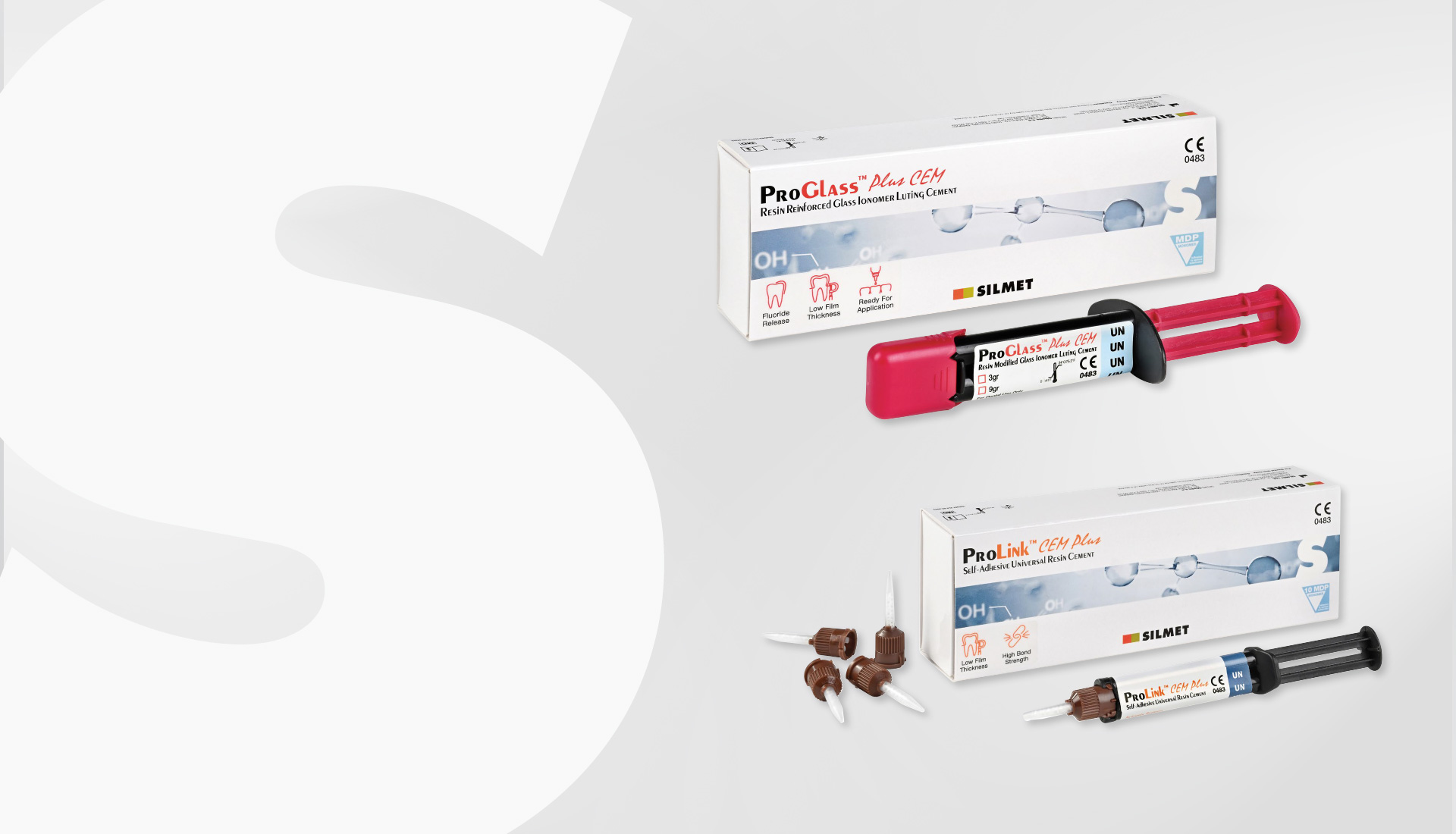
ProLink Cem Primer is formulated around this chemistry. It contains dual coupling agents, 10-MDP and silane methacrylate, and is intended for zirconia, alumina, and metal substrates. It works in total-etch, self-etch, or selective-etch protocols and is compatible with both light-cured and dual-cured resin cements, which makes it suitable for the priming step described above in cases where the preparation has limited mechanical retention.
ProLink CEM PLUS is our self-adhesive universal resin cement, formulated with two functional monomers and used in self-cure, light-cure, or dual-cure modes. It has a shear bond strength to zirconia of 28 to 32 MPa, a film thickness of 17 microns, and is radiopaque for evaluation under X-ray. On preparations with adequate mechanical retention, it can be used without a separate primer step. When retention is limited, pairing it with ProLink Cem Primer adds the chemical bonding component that a self-adhesive cement alone may not fully provide on zirconia.
Together, the primer addresses the surface chemistry and the cement addresses seating, cure, and long-term stability.
Zirconia does not etch or bond to silane the way glass-ceramics do, so a primer containing a phosphate monomer such as 10-MDP is generally recommended, particularly when the preparation does not offer strong mechanical retention on its own. ProLink Cem Primer is formulated for this purpose, using dual coupling agents (10-MDP and silane methacrylate) to target zirconium oxide as well as alumina and metal substrates.
It depends on the cement's formulation and the retention available in the preparation. A self-adhesive resin cement with a functional monomer, like ProLink CEM PLUS, can be used on zirconia without a separate primer step when the preparation provides adequate retention. In lower-retention cases, adding a compatible primer step is the more predictable approach, since it introduces the chemical bonding component the cement alone may not fully supply.
Even with a well-designed preparation, debonding can still occur if the intaglio surface was contaminated after air abrasion or priming, if the primer did not have enough time to react before rinsing or cementation, or if the cement used was not formulated with a monomer capable of bonding to zirconium oxide. Isolation and cure completion at the time of cementation also play a role, since moisture contamination or incomplete polymerization can weaken the bond even when the surface treatment itself was done correctly.