Choosing between composite and resin-modified glass ionomer cement for a direct restoration typically depends on what the tooth and the clinical setting can tolerate rather than which material performs better in theory. A resin-modified glass ionomer sacrifices some wear resistance and esthetics compared to composite, but it gains chemical adhesion, fluoride exchange, and a working window that holds up better under imperfect isolation. Knowing which of those trade-offs matters most for a given case supports more predictable, longer-lasting restorative outcomes.
High caries risk patients may benefit from the sustained fluoride release and uptake that resin-modified glass ionomer provides at the margin, which can help reduce the likelihood of recurrent decay around the restoration compared to a material with no fluoride exchange.
Cervical lesions, particularly non-carious cervical lesions and Class V restorations, are a common indication because these preparations are shallow, close to the gingival margin, and often difficult to isolate and keep dry. The chemical bond to dentin that resin-modified glass ionomer forms through polyacrylic acid, independent of a separate bonding agent, makes it more forgiving in this location than a composite that depends entirely on an intact adhesive bond.
Root surface restorations present similar challenges. Root dentin has a different composition and moisture profile than coronal dentin, and it is frequently exposed in patients with recession where isolation is already compromised. A resin-modified glass ionomer restoration placed here tends to tolerate the moisture and substrate variability better than a bonded composite.
Moisture-challenged cases, such as pediatric patients, restorations near the gingival sulcus, or situations where rubber dam isolation is not practical, are where resin-modified glass ionomer's relative moisture tolerance during placement becomes a meaningful clinical advantage.
Adhesion is achieved through different mechanisms. Composite relies on micromechanical retention into etched enamel and dentin via a separate adhesive system, while resin-modified glass ionomer chemically bonds to tooth structure through the reaction between polyacrylic acid and calcium in the hydroxyapatite, in addition to the resin component's light-cured set.
Fluoride release is a defining difference. Resin-modified glass ionomer releases fluoride during the initial period after placement and can recharge from topical fluoride exposure over time, while conventional composite does not release or recharge fluoride.
Moisture tolerance separates the two materials clinically. Resin-modified glass ionomer's setting reaction is less disrupted by a wet field during placement than composite's adhesive bonding step, which is one of the main reasons it gets selected for cases where isolation cannot be fully controlled.
Mechanical properties favor composite. Universal composite generally has higher wear resistance, compressive strength, and fracture toughness, which is why resin-modified glass ionomer is typically reserved for lower-stress locations rather than large posterior occlusal restorations that need to withstand direct occlusal load over years of function.
Functional demands on the restoration matter first. A restoration in direct occlusal contact with heavy chewing forces has different mechanical requirements than a Class V restoration near the gingival margin, and the material selected should match those demands rather than default to habit.
Esthetics play a smaller but still relevant role. Resin-modified glass ionomer is more opaque and less color-stable over time than composite, so it is a better fit for restorations where esthetics is a secondary concern relative to adhesion and fluoride release, such as posterior Class V lesions or restorations at sites with lower esthetic demands.
The level of isolation achievable at the time of placement is often the deciding factor in practice. If a dry field can be reliably maintained, composite's mechanical properties usually make it the better choice for load-bearing areas. If isolation is inconsistent, the reduced technique sensitivity of resin-modified glass ionomer becomes more valuable than composite's superior strength.
The patient risk profile ties the other factors together. A high caries risk patient with several exposed root surfaces and inconsistent isolation is a very different case from a low caries risk patient needing a straightforward Class I restoration, and material choice should reflect that difference rather than apply one material to every situation.
Case selection is the most frequent source of clinical disappointment. Placing resin-modified glass ionomer in a large, stress-bearing posterior restoration and expecting composite-level wear resistance increases the risk of early failure, since the material was not designed to carry that mechanical load long term.
Finishing errors can compromise an otherwise well-placed restoration. Contouring and polishing too soon, before the material has reached adequate hardness, can disrupt the surface and reduce wear resistance and color stability at the margin.
Moisture management still matters even though resin-modified glass ionomer tolerates a wetter field better than composite. Excess moisture during the initial set, or dehydration of the material immediately after placement, can both affect the working properties and the final set, so some degree of isolation and post-placement protection is still worth maintaining.
Occlusal considerations are an important but sometimes overlooked factor. Even in a case where resin-modified glass ionomer is otherwise appropriate, failing to check and adjust occlusal contacts can concentrate force on a material that is not intended to bear heavy functional load, which shortens the restoration's clinical lifespan.
Handling in current formulations is generally more predictable than earlier generations of glass ionomer. Capsule-based delivery, consistent working time, and light-cured initial set give the clinician more control over placement and contouring compared to older hand-mixed powder-liquid systems.
Clinical indications for a light-cured, reinforced glass ionomer restorative typically include Class I, Class II, and Class V restorations, along with secondary uses such as liners and bases under other restorative materials.
Long-term performance depends on placement technique as much as material chemistry. A resin-modified glass ionomer used within its intended indications, with reasonable moisture control and correct finishing, can be expected to release fluoride over time, resist marginal breakdown reasonably well, and maintain the chemical bond to tooth structure that makes it useful in cervical and root surface cases.
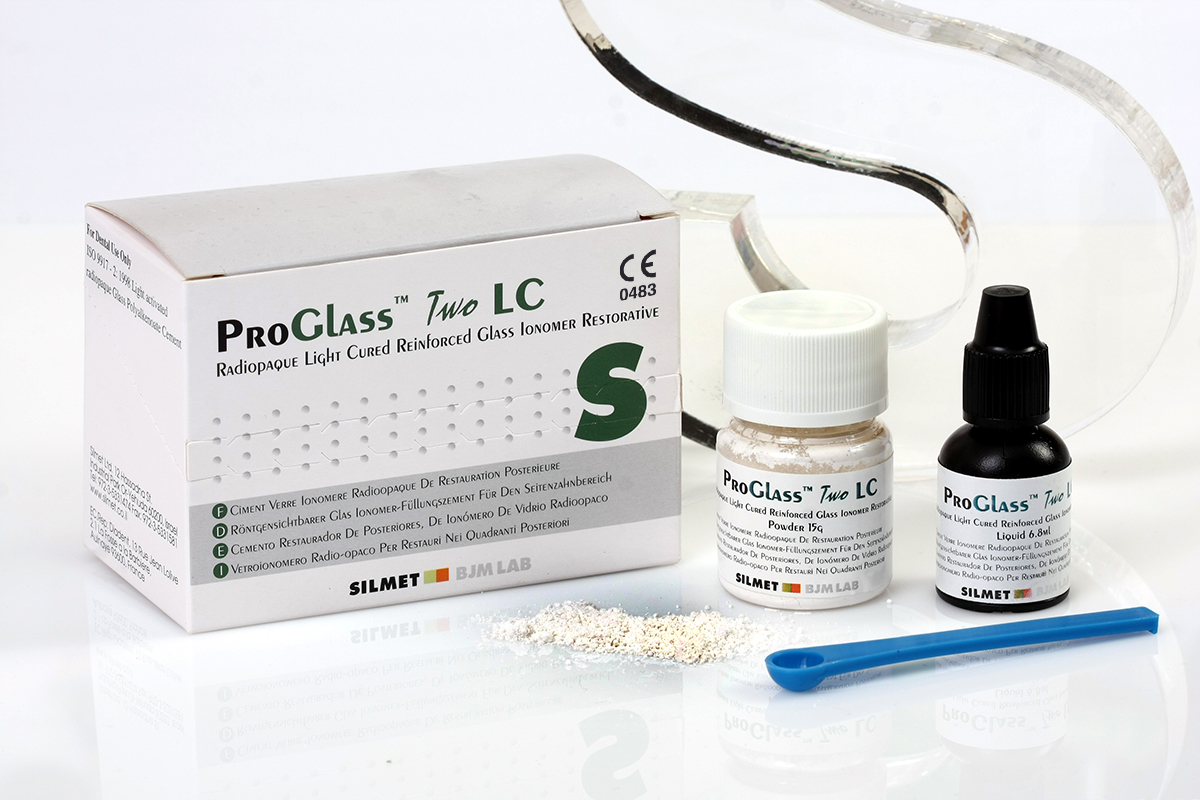
ProGlass Two LC is our light-cured, reinforced glass ionomer restorative, formulated with smaller particles for restorative fillings as well as liner and base indications. It has a compressive strength of 140 MPa or greater, a working time of 2 to 4 minutes, and does not contain Bisphenol A or its derivatives. Its low acid erosion value is intended to help resist the disintegration and wear that oral acidity can cause over time. Its light-cured set is also paired with a secondary chemical set, sometimes described as a dark cure, so the material continues to mature in areas the curing light does not directly reach. Given its fluoride release, chemical adhesion to tooth structure, and formulation for restorative fillings, liners, and bases, it fits the direct restoration indications this article has covered rather than functioning as a cement for indirect restorations.
Selecting the right dental restorative material depends on balancing the patient's caries risk, functional demands, esthetic expectations, and the clinical environment.
It tends to be the better choice when isolation is difficult to control, when the restoration is in a location with lower functional load, such as a cervical or root surface lesion, or when the patient's caries risk makes ongoing fluoride release clinically useful. In cases with reliable isolation and higher functional demand, composite's mechanical properties usually make it the more appropriate material.
It is not generally recommended for large, stress-bearing posterior restorations that need to withstand significant occlusal load over time, since its mechanical properties, including wear resistance and fracture toughness, are lower than composite's. It is better suited to Class I, II, and V restorations within its intended indications, along with liner and base applications.
No separate bonding agent is required for the chemical adhesion component, since resin-modified glass ionomer bonds to tooth structure directly through the reaction between its polyacrylic acid component and the tooth's mineral content. This is one of the practical differences from composite, which depends on a separate adhesive system to achieve retention.