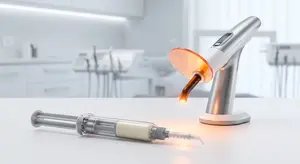
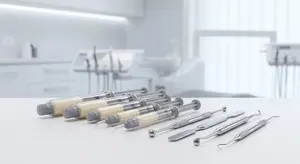
Successful crown cementation begins long before the restoration reaches the operatory. The restoration material, preparation geometry, available retention, and clinical workflow all influence which luting cement is most appropriate. A cement that performs well for one indication may not provide the same outcome in another. Selecting the right material means evaluating the clinical situation rather than relying on a single cementation approach for every case.
Crown cementation is the process of securing an indirect restoration to the prepared tooth or implant abutment for long-term use, using a dental resin cement or another luting material. The cement creates the interface between the restoration and the supporting structure, helping maintain retention, seal the margins, and support long-term function.
Modern restorative dentistry offers a wide range of crown materials, including full metal, porcelain-fused-to-metal (PFM), lithium disilicate, and other all-ceramic restorations. Since these materials differ in their mechanical properties and bonding requirements, cement selection should be based on the restoration and the clinical conditions rather than following a single routine.
Restoration Material
Restorative materials interact differently with cement systems. Metal restorations, glass ceramics, and high-strength ceramics have different surface characteristics, which may influence the preferred adhesive resin cement or cementation protocol.
Preparation Design and Retention
Preparation geometry remains one of the most important clinical factors. Height, taper, and surface area determine how much mechanical retention is available before the cement is placed.
When preparation retention is compromised because of limited wall height or excessive taper, clinicians often consider a dental resin cement that provides stronger adhesion than conventional cements. When adequate retention is already present, a simplified self-adhesive workflow may be appropriate depending on the restoration and manufacturer recommendations.
Bonding Requirements
Not every indirect restoration requires the same bonding protocol. Some restorations benefit from adhesive bonding to maximize retention, while others can be successfully placed with self-adhesive resin cements when the clinical conditions are favorable.
Understanding whether the restoration depends primarily on mechanical retention, adhesive bonding, or a combination of both helps narrow the cement selection.
Moisture Control
Moisture management can affect the predictability of adhesive procedures. Situations where complete isolation is difficult may influence the clinician's choice of cementation approach.
Esthetic Considerations
For highly esthetic restorations, the optical properties of the cement may influence the final appearance. Shade stability, film thickness, and the interaction between the restoration and the underlying tooth should all be evaluated during treatment planning.
Handling Characteristics
Clinical efficiency also depends on how the material handles during placement. Working time, flow behavior, cleanup after the gel phase, curing mode, and film thickness can all influence the cementation procedure, particularly in multi-unit restorative cases.
Full Metal Crowns
Full metal crowns generally rely on mechanical retention created by the tooth preparation. When preparation design provides sufficient resistance and retention, clinicians may choose a self-adhesive resin cement that simplifies the workflow while maintaining reliable performance.
Porcelain-Fused-to-Metal Crowns
PFM restorations combine a metal substructure with ceramic veneering. Cement selection depends largely on the preparation rather than the veneering porcelain.
When adequate retention is available, a self-adhesive luting cement may reduce clinical steps while providing predictable handling. Cases with reduced retention may benefit from a more adhesive-focused cement when clinically indicated.
All-Ceramic Crowns
All-ceramic restorations vary considerably in composition, so they should not all be approached identically during dental cementation procedures.
Some materials depend more heavily on adhesive bonding, while others may allow simplified cementation protocols depending on the restoration design, preparation, and manufacturer instructions. Evaluating these factors together helps determine whether a self-adhesive or more adhesive-focused approach is appropriate.
Lithium Disilicate Crowns
Lithium disilicate restorations are widely used because they combine esthetics with favorable mechanical properties. Their long-term performance depends not only on restoration design but also on following the recommended bonding protocol for the ceramic system being used. Surface conditioning and the selected adhesive resin cement should follow the manufacturer's clinical recommendations for the specific restorative material.
Implant-Supported Crowns
Cementation of implant-supported crowns introduces additional considerations beyond tooth-supported restorations. Excess cement around implant restorations has been associated with biological complications such as peri-implant tissue inflammation, making controlled cement application and effective cleanup important parts of the procedure. Choosing a cement with predictable handling characteristics can help simplify excess removal during seating.
Inlays and Onlays
Indirect inlays and onlays often preserve more natural tooth structure than full-coverage crowns. Their preparation design may provide less mechanical retention than conventional crowns, making adhesive performance an important part of the restorative procedure. The restoration material, preparation design, and bonding protocol should all be evaluated before selecting the final cement.
Conventional cementation and dental adhesive cementation serve different clinical purposes and are not interchangeable in every case.
Conventional cementation relies primarily on the mechanical retention created during tooth preparation. When preparation geometry provides sufficient resistance and retention, this approach may be appropriate for many indirect restorations.
An adhesive resin cement provides both sealing and additional bonding for the restorative procedure. It may be selected when increased retention is desirable, when restoration geometry is less favorable, or when the restorative material benefits from adhesive bonding.
Rather than asking which approach is better, clinicians generally evaluate which method best matches the restoration, preparation, and clinical objectives.
Inadequate Retention
Loss of retention may occur when preparation geometry alone cannot provide sufficient resistance or when the selected cement does not match the clinical indication. Evaluating preparation height, taper, restorative material, and bonding requirements before cement selection helps reduce this risk.
Marginal Gaps and Microleakage
Marginal adaptation depends on several clinical factors, including restoration fit, preparation quality, isolation, and cement handling. Selecting a dental resin cement with low film thickness and following the recommended placement protocol helps support accurate restoration seating.
Excess Cement Removal
Residual cement can complicate cleanup, particularly around subgingival margins and implant restorations. Materials with predictable working characteristics and controlled flow may simplify excess removal before final polymerization.
Post-Operative Sensitivity
Sensitivity after indirect restorations may result from several clinical factors, including preparation depth, dentin exposure, bonding technique, and marginal sealing. Careful isolation, following the recommended cementation protocol, and selecting appropriate materials all contribute to reducing potential complications.
Moisture Contamination
Contamination during the bonding procedure may interfere with adhesion in some restorative protocols. Isolation techniques should be selected according to the restoration type and the manufacturer's recommended cementation procedure.
Many clinicians look for cement systems that reduce procedural complexity without limiting restorative options.
Our ProLink CEM and ProLink CEM PLUS are self-adhesive dental resin cement systems developed for permanent cementation of indirect restorations. Both materials support dual-cure polymerization and, in appropriate indications, are designed to simplify clinical workflows by reducing unnecessary treatment steps. Their low film thickness, radiopacity, and predictable handling characteristics are intended to support accurate restoration seating and easier excess cement removal.
The final selection should still be based on the restoration material, preparation design, and the clinical requirements of each individual case.
Every restorative case presents a different combination of materials, preparation designs, and clinical objectives. Our approach is to provide cementation solutions that allow clinicians to match the material to the clinical indication.
Our ProLink cementation portfolio includes self-adhesive resin cements developed for permanent indirect restorations, supporting a range of restorative procedures while maintaining a simplified clinical workflow where appropriate.
What is the difference between a self-adhesive resin cement and a conventional resin cement?
Self-adhesive resin cements are designed to simplify the cementation procedure by reducing the number of clinical steps required before placement. Conventional resin cements typically require a separate bonding protocol that may include tooth conditioning and the application of an adhesive system. The appropriate choice depends on the restoration, preparation design, and the clinical objectives. At Silmet, our ProLink CEM and ProLink CEM PLUS are self-adhesive resin cements developed to support permanent cementation while streamlining the clinical workflow in appropriate indications.
Can one resin cement be used for different types of crown restorations?
A single dental resin cement may be suitable for multiple indirect restorations, but it should not be selected solely for convenience. Crown material, preparation geometry, retention, and the recommended cementation protocol should all be considered before treatment. We recommend evaluating each case individually to determine whether a self-adhesive resin cement is appropriate for the restoration being placed.
What features should clinicians look for in a permanent dental crown cement?
The most appropriate permanent dental crown cement depends on the clinical indication, but many clinicians consider factors such as bond strength, film thickness, radiopacity, handling characteristics, working time, and excess cement removal. Compatibility with the planned restoration and a predictable cementation workflow are also important. Our ProLink CEM and ProLink CEM PLUS are designed with these clinical considerations in mind, providing self-adhesive resin cement options for a wide range of permanent indirect restorations.
%20(1).webp)