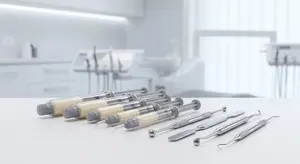
A typical dental practice may use composite materials for a wide range of direct restorations, from small anterior repairs to larger posterior cavities. These cases can create different demands on handling, adaptation, depth of cure, and esthetics. A universal composite can cover many routine procedures, but flowable and bulk-fill materials may offer practical advantages in specific situations.
The key is understanding where each category adds clinical value and whether it supports the restorative procedures your practice performs most often.
A dental composite is a tooth-colored restorative material used for direct restorations. It combines a resin matrix with inorganic fillers, photoinitiators, pigments, and other components that influence handling and physical performance. Changes in filler content, particle size, and resin formulation create materials with different viscosities, strengths, polishability levels, and curing characteristics.
This is why universal, flowable, and bulk-fill composites should not be viewed as interchangeable products. Each category is developed to address a different clinical need.
For example, a dentist restoring an anterior Class IV fracture may prioritize sculptability and shade matching. A deep posterior restoration may require a different handling profile or placement technique. Using the same composite for both procedures may be possible, but it is not always the most efficient approach.
When reviewing composite options, it helps to think beyond individual products and focus on restorative workflows. Instead of asking, "Which composite is the best?" a more useful question is, "Which composite categories support the procedures we perform every day?"
A universal composite is often the starting point for practices that want one material capable of handling a broad range of direct restorations. It is designed to provide a balance between strength, esthetics, and handling rather than being optimized for one specific indication.
Because of that versatility, many clinics rely on a universal composite for routine anterior and posterior restorations. It can simplify inventory management while allowing clinicians to maintain a consistent placement technique across different cases.
Our ProFil composite was developed with this type of workflow in mind. It is a light-cured, radiopaque microhybrid composite indicated for both anterior and posterior restorations. According to its indications for use, it can be used for Class I through Class V restorations, veneering discolored anterior teeth, reconstruction of traumatically damaged anterior teeth, splinting, and orthodontic appliance anchoring. Its non-sticky handling and polish retention may help clinicians shape and finish restorations with greater control across different clinical situations.
That broad indication range makes a universal composite a practical foundation for many practices. However, a versatile material is not necessarily the right choice for every clinical situation. Clinical factors such as cavity size, access, restoration location, and the preferred placement technique may still make another composite category a better choice.
For example, placing material in a conservative preparation often benefits from a lower-viscosity composite, while some posterior restorations may call for a firmer, more packable consistency. Rather than replacing a universal composite, these categories provide additional handling options for specific restorative procedures.
Practices evaluating whether to add another composite category may benefit from reviewing their restorative workflow to determine which composite categories best match the procedures performed most often.
A flowable dental composite is designed with a lower viscosity than a conventional restorative composite. That difference changes how the material behaves during placement rather than making it a replacement for a universal composite.
The lower viscosity allows the material to adapt more readily to prepared surfaces and internal aspects of a cavity. Depending on the clinical indication and the manufacturer's instructions, this can be useful when working in areas where adaptation is more challenging with a packable material.
Many clinicians keep a flowable composite available because it fills a different role in the restorative workflow. Instead of replacing the primary restorative material, it complements it. A universal composite may be used to build the restoration, while a flowable composite can be selected for situations where its handling characteristics provide an advantage.
Our ProFil Flow is a visible-light-activated, radiopaque flowable microhybrid composite developed using the same resin technology as the ProFil composite system. It is indicated for cavity filling applications and combines a low-viscosity consistency with strength and wear resistance for its approved restorative uses.
That distinction is important because not every restoration benefits from a highly flowable material. Lower viscosity improves adaptation, but it also changes how the material handles during placement. Material selection should therefore reflect both the restorative objective and the manufacturer's recommended indications.
A practice that performs a high number of conservative restorations, small occlusal repairs, or procedures where adaptation is a priority may find that adding a dedicated flowable dental composite improves handling without significantly increasing inventory complexity.
One of the biggest differences between conventional composites and bulk-fill composites is the intended placement technique.
Traditional light-cured composites are commonly placed in increments because light penetration and polymerization depth influence how much material can be predictably cured at one time. Bulk-fill materials are developed to support placement in thicker increments according to the manufacturer's instructions.
For many practices, this is less about changing restorative principles and more about improving workflow. Bulk-fill materials are often selected to simplify placement workflows by reducing the number of increments when the clinical situation and the manufacturer's instructions support that approach.
Our ProFil Bulk takes a different approach from conventional light-cured composites. It is a dual-cure restorative composite developed for direct posterior restorations using the bulk-fill technique. According to our product information, ProFil Bulk is suitable for posterior bulk-fill techniques, features a dual-cure mechanism, and can be applied in increased layer thickness compared to conventional composites, per manufacturer instructions.
This curing method distinguishes it from many traditional bulk-fill materials. Even so, material selection should still be guided by the clinical situation rather than the curing mechanism alone. Factors such as cavity design, access, matrix placement, occlusion, and finishing requirements remain part of every restorative procedure.
Choosing a bulk-fill composite also does not mean abandoning incremental techniques altogether. Many clinicians continue to use different placement strategies depending on the restoration being treated. The goal is to select the approach that best fits the individual case rather than applying the same technique universally.
Practices that routinely perform posterior direct restorations may consider a bulk-fill composite when its placement technique aligns with their preferred workflow.
Practices considering whether a bulk-fill or flowable composite would improve their restorative workflow may benefit from comparing the clinical role of each category to determine whether adding another composite complements their current system or simply adds unnecessary inventory.
Do I need all of the composite categories in my practice?
The right combination depends on the restorative procedures you perform most often. Many practices use a universal composite as their primary restorative material and add other categories only when they provide a clear clinical or workflow advantage. For example, a flowable dental composite may improve adaptation in selected cases, while a bulk-fill composite may be valuable if posterior restorations make up a significant portion of your daily workload. We recommend building your composite selection around your case mix rather than stocking every available material.
Can composites from the same product family simplify inventory management?
Using materials developed within the same composite system can make inventory management and clinical workflows more consistent. Our ProFil family includes a universal composite, a flowable composite, and a bulk-fill composite, allowing clinicians to select different handling characteristics while working within a compatible restorative system. This approach can reduce the need to learn multiple material systems while still providing options for different clinical situations.
How do I know if it is time to add another composite category?
If you regularly adjust your placement technique because your current composite does not provide the handling characteristics you need, it may be worth evaluating another category. For example, repeatedly using a universal composite where improved flow or a more packable consistency would be helpful may indicate that your restorative workflow could benefit from a dedicated flowable or bulk-fill composite. If you are unsure which category best fits your practice, our team can help you review your restorative procedures and identify the materials that align with your clinical needs.
%20(1).webp)