Resin-modified glass ionomer cement (RMGI) keeps the acid-base setting reaction of conventional glass ionomer and adds a resin component that polymerizes. Depending on the formulation, this can improve handling and early strength. It doesn't make every RMGI suitable for every procedure.
When you pick a material for a liner, base, restoration or crown cementation, the composition, curing method and labeled indications decide where a product fits. An RMGI luting cement, for example, isn't automatically suitable for a direct restoration or a cavity liner.
Conventional glass ionomer cement (GIC) sets through an acid-base reaction between an aqueous polyacid and reactive glass powder. RMGI keeps that reaction and adds polymerizable resin components.
The resin is most often light-activated. Some formulations cure chemically, and others combine both. The exact chemistry depends on the product.
RMGI materials generally keep these glass ionomer features:
The resin changes how the material handles and sets. You still need to follow the manufacturer's steps for placement, curing and moisture control.
Two reactions run side by side.
Acid-base reaction. The polyacid reacts with the glass particles and releases ions that build the cement matrix. This reaction continues after the initial set, so properties keep developing over time.
Resin polymerization. The resin phase hardens once its activation conditions are met. In a light-cured product, that means the specified curing light, exposure time and layer thickness. Some products also have chemical or dual-cure mechanisms, so don't assume the cure type from the RMGI label alone.
In practice, light exposure gives you the initial set, but the cement keeps maturing afterward. Follow the instructions for finishing, polishing and any surface protection.
These materials overlap in some applications, but their composition and handling differ.
| Feature | Conventional GIC | RMGI | Resin composite |
|---|---|---|---|
| Main setting mechanism | Acid-base reaction | Acid-base reaction plus resin polymerization | Resin polymerization |
| Adhesion to tooth | Chemical adhesion | Chemical adhesion, with product-specific resin contributions | Usually needs an adhesive system unless the product is self-adhesive |
| Fluoride release | Commonly releases fluoride | Commonly releases fluoride | Depends on formulation; don't assume conventional composites release fluoride |
| Moisture management | Critical during early setting | Early moisture sensitivity may be lower in some formulations, but isolation still matters | Moisture control suited to the adhesive and composite system |
| Curing | Usually chemical setting | Light-cure, chemical-cure or dual-cure, depending on formulation | Light-cure or another specified mechanism |
| Common applications | Restorations and luting, depending on the product | Restorations, liners, bases or luting, depending on the product | Direct restorations and selected other uses, depending on the product |
Exact performance depends on the product.
A 2024 review in the Journal of Dental Sciences covers the clinical use of conventional and resin-modified glass ionomers. It supports their use as restorative materials, luting cements and sealants, and calls their use as liners and bases debatable.
RMGI in dentistry has several applications, from cavity lining and restorative fillings to luting indirect restorations. The right choice depends on the product's intended use and clinical requirements.
Start with what the material has to do. A product's chemistry doesn't tell you its indication.
RMGI can work as a liner or base when the specific product is indicated for it. Consider the remaining dentin, the restorative material, the permitted thickness, the curing method and what the definitive restoration requires. Don't assume a luting or restorative glass ionomer is also cleared for lining.
Silmet's ProBase is a light-cured reinforced glass ionomer made for this job. It is intended as a liner or base under composite, amalgam, ceramic and metal restorations, with a recommended setting time of 20 seconds and compressive strength of at least 140 MPa.
Check each product's instructions for its exact classification. For guidance on whether a preparation needs a liner at all, see our article on cavity liners.
Some resin-modified glass ionomers are formulated for restorations, but suitability depends on the cavity and the product's indications. Consider cavity location, expected occlusal load, esthetic requirements, available isolation and finishing. Compressive strength alone doesn't settle the question.
An RMGI luting cement attaches an indirect restoration to the prepared tooth or another specified substrate. The retention and resistance form of the preparation, the restorative material, the isolation available and the cementation protocol all affect your choice.
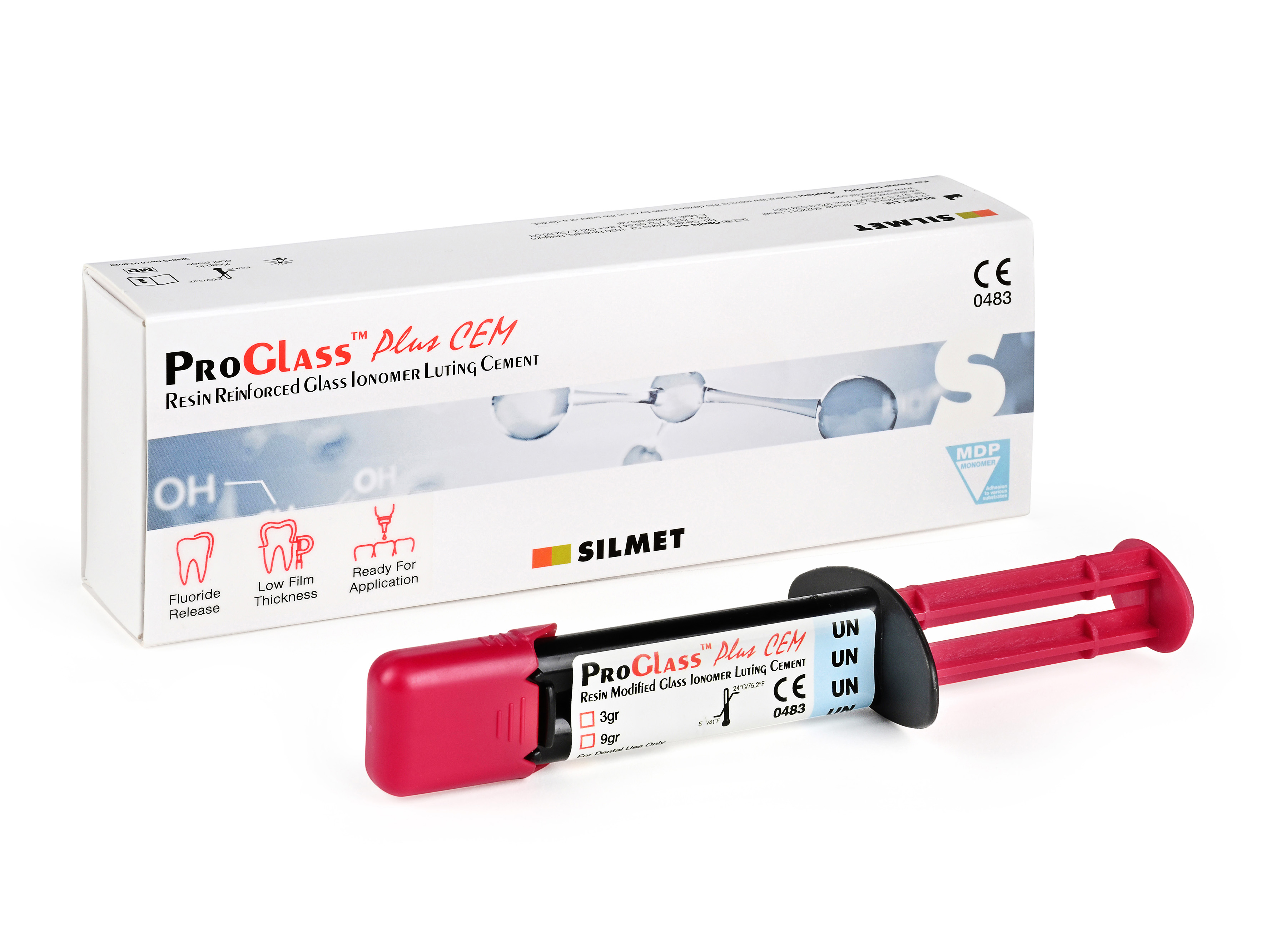
ProGlass Plus Cem is a self-adhesive RMGI luting cement for permanent cementation. It can be used in self-cure, light-cure or dual-cure mode, and the tack-cure option makes excess easier to clean up. Silmet lists a working time of 3 minutes plus or minus 30 seconds and a setting time of 5 minutes or less. It suits cases where the preparation gives good retention.
It's a luting cement, not a general-purpose substitute for restorative glass ionomer. Follow its instructions for restoration type, substrate preparation, seating and cleanup.
ProGlass Plus is Silmet's resin-reinforced glass ionomer luting cement, with its own indications and handling requirements.
Resin modification isn't an upgrade for every case. Conventional glass ionomer still makes sense where its setting behavior, adhesion and labeled use match the need. RMGI makes sense where the added resin phase gives you the handling you want. Choose based on the procedure, not on the assumption that a resin-containing cement is stronger.
Conventional glass ionomer is vulnerable to moisture contamination and dehydration while it sets. Some RMGI formulations are less sensitive to early moisture problems. That doesn't make an uncontrolled wet field acceptable, and composites have their own isolation requirements, especially during adhesive application.
Follow the product's instructions for:
Don't carry the protocol of one glass ionomer over to another. A light-cured restorative, a conventional cement and a dual-cure luting material can each have different requirements.
Capsules give you a defined unit for mechanical mixing and help standardize handling when several clinicians use the same material. They don't guarantee identical mixing or performance across products.
Before choosing a capsule, check:
RMGI is useful in defined situations. It isn't interchangeable with conventional GIC, resin composite or resin cement.
A product description should be backed by technical documents that answer practical questions. Look for:
Silmet publishes instructions for use and safety data sheets for each product. Read the ones for the exact product you plan to use, because requirements differ across the glass ionomer range.
RMGI products serve different purposes depending on their formulation and labeled indications. For a dedicated liner or base, see ProBase. For permanent cementation with a self-adhesive RMGI, see ProGlass Plus Cem. Read the instructions and technical specifications for your chosen product before using it in your practice.
Yes, when the specific RMGI luting cement is indicated for the restoration and clinical situation. Check the preparation's retention, the restoration material and the cement's instructions. ProGlass Plus Cem is a self-adhesive RMGI cement intended for permanent cementation.
No. Some are light-cured, some are chemically cured, and others are dual-cure. Check the product instructions rather than relying on the RMGI label.
Manufacturers use both terms for related formulations, but the wording alone doesn't confirm the same composition or setting mechanism. Check the manufacturer's stated classification and technical documentation.
Confirm that your device and its settings match the capsule instructions. Mixing time and equipment requirements can differ between products even when the capsules look alike.
Start with the relevant product page, which links to its technical documents. The Silmet IFU directory lists instructions by product.