During selective enamel etching, the gel needs to stay within the area being treated. If it spreads onto dentin, the planned technique can change. Rinsing matters too, since the tooth must be prepared for the next bonding step according to the adhesive manufacturer's instructions.
Phosphoric acid etchants are commonly supplied as etchant gels at roughly 35% to 37%, and concentration alone rarely separates one product from another. Viscosity, tip design, rinsability and fit with the bonding protocol often matter more in daily use.
At Silmet, we manufacture ProEtch 37% phosphoric acid gel for etching enamel and dentin before composite placement. The notes below apply to any etchant, ours included.
Enamel is highly mineralized. Phosphoric acid removes a small amount of mineral from its surface and leaves microscopic irregularities that adhesive resin can flow into, which is the basis of micromechanical retention at enamel margins. After rinsing and drying, etched enamel generally looks matte or frosted. That appearance is a useful visual cue, although it cannot confirm that the rest of the bonding sequence was carried out correctly.
Dentin contains minerals, collagen and water, so it responds differently. Etching generally removes the smear layer and demineralizes the superficial dentin, which exposes a collagen network. What matters afterward is whether the adhesive can infiltrate that network. Some adhesives are designed for visibly moist dentin and others for a different surface condition, so etching time, rinsing and drying are best read together with the instructions of the adhesive being used.
Phosphoric acid between about 30% and 40% is widely used to condition enamel and dentin, and commercial etchants commonly sit at 35% or 37%. These figures have a long track record in adhesive dentistry, but a higher number does not make an etchant more effective. Gel formulation, substrate, contact time and the adhesive applied afterward all influence the result, so two gels with the same percentage may not behave identically. A familiar percentage helps identify the formulation, and the instructions for use still define how it is applied.
These terms describe the bonding technique, not the etchant, and the adhesive system decides which one applies.
| Approach | How it works | What to consider |
|---|---|---|
| Total-etch (etch-and-rinse) | Phosphoric acid is applied to enamel and dentin, then rinsed off before the adhesive steps | Dentin has to be left in the condition the adhesive calls for |
| Selective enamel etching | Phosphoric acid is applied to enamel only; dentin is treated according to the adhesive | Placement precision decides whether dentin is etched unintentionally |
| Self-etch | An acidic primer or adhesive conditions the tooth, with no separate phosphoric acid step on dentin | Some protocols still recommend phosphoric acid on enamel |
Total-etch suits adhesives built around a separate etching step. The dentin condition after rinsing differs between products, so the same drying habit may not work across adhesives.
Selective enamel etching is useful when a preparation combines enamel margins with a large area of exposed dentin. It is often paired with self-etch and universal adhesives. Gel that spreads onto dentin turns the technique into a total-etch, which is why placement control matters here. A 2024 continuing education article reviews the selective enamel etch technique and the evidence behind it.
Self-etch adhesives contain acidic components that condition the tooth as they are applied, so they do not need a separate phosphoric acid step on dentin. Some manufacturers still recommend etching enamel alongside them, so the adhesive's instructions decide. Phosphoric acid used with one bonding system should not be carried over to dentin in another out of habit.
When choosing a dental acid etch, dentists and distributors need to look at how the gel performs during treatment, as well as its packaging, shelf life and availability.
The dental etching gel has to stay where it is placed for the full application time. A gel that runs past the preparation may condition surfaces that were never meant to be etched, and one that is hard to direct makes the treated area harder to control. When comparing gels, these are worth checking:
Suitable isolation and keeping gel off soft tissue are covered in the safety data sheet of the product in use.
Etchant left behind. Residual gel can interfere with the next steps, and a faded color does not guarantee that all of it is gone. Rinse for the time given in the instructions for use of the etchant and the adhesive. Our guide to phosphoric acid etching covers technique in more detail.
Drying dentin too far. After an etch-and-rinse step, excessive air drying may collapse the exposed collagen network and limit resin infiltration. The right endpoint depends on the adhesive, and a protocol written for moist dentin should not be swapped for one written for another system.
Saliva or blood contamination. Contamination after etching can interfere with bonding. The adhesive manufacturer's instructions generally describe what to do when it happens. Re-etching is sometimes part of that, depending on the contaminant and the adhesive, so it is better not treated as a default fix.
For a practice or a distributor, selection usually combines clinical handling with purchasing details:
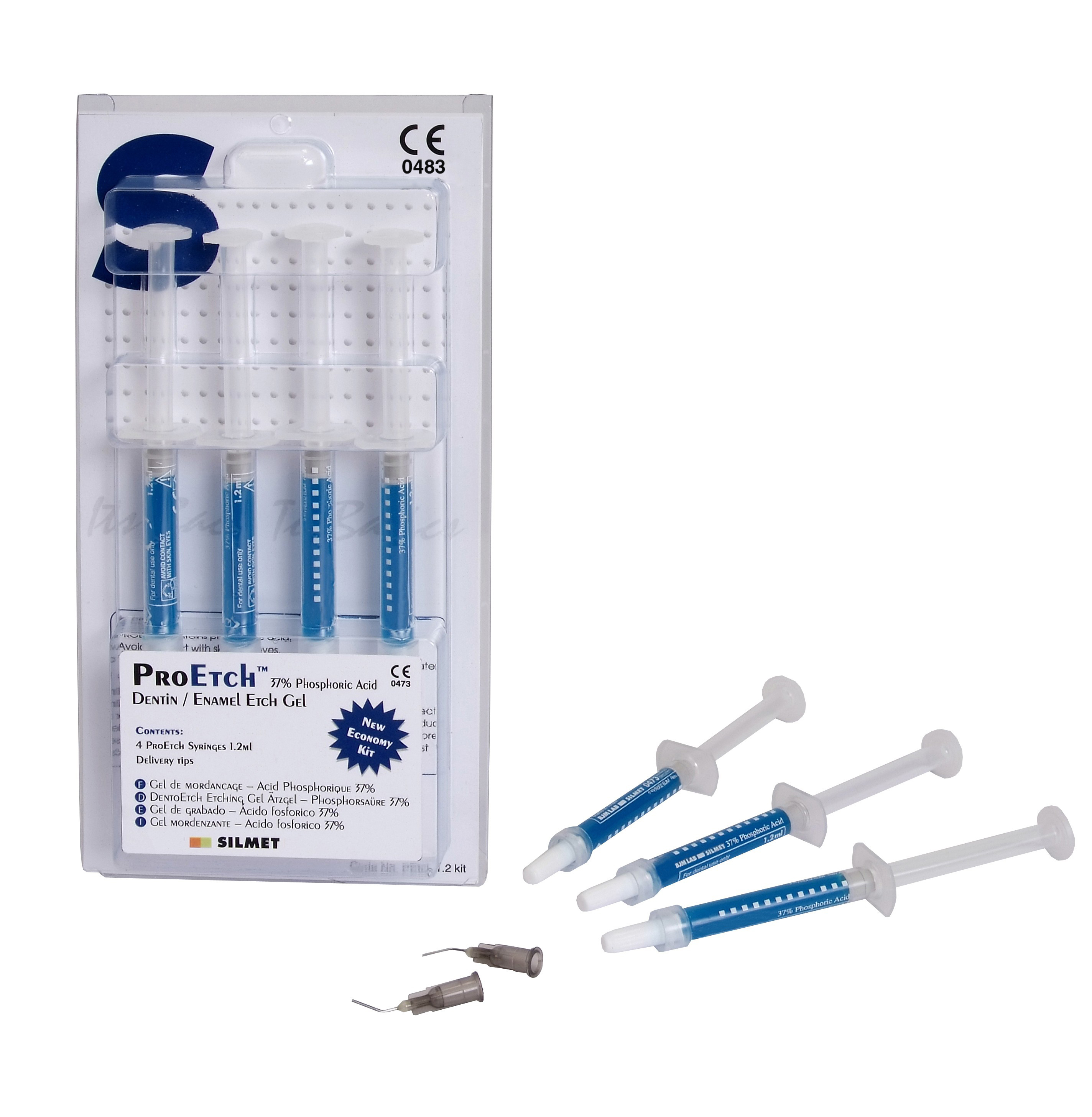
ProEtch is a 37% phosphoric acid gel with a medium viscosity described as non-drying and resistant to running. It has a visible color, dissolves in water and comes in large, comfortable-to-use syringes with disposable tips that can be angled for distal and lingual preparations. It is supplied in three formats, and the safety data sheet is available for download.
| Pack format | Product code |
|---|---|
| 4 x 1.2 ml syringes | 190100 |
| 24 x 1.2 ml syringes | 190124 |
| Jumbo pack, 1 x 60 g | 190160 |
The 4-syringe pack may suit lower or occasional use, while the 24-syringe and jumbo formats may be worth comparing for higher volume or distribution.
An etchant is worth judging on handling and fit with the bonding protocol as much as on its percentage. Pack options for ProEtch are on the product page, and Silmet's instructions for use cover etching and rinsing for the product.
A gel made for enamel and dentin is not automatically suitable for ceramic. Glass ceramics and zirconia generally call for different surface treatments, and the restorative material's instructions decide. For the zirconia side, see our guide to cementing zirconia crowns.
No. An etchant conditions the tooth surface, while a bonding agent creates the adhesive link between tooth and restoration. Self-etch systems combine acidic conditioning and bonding in one product, but in an etch-and-rinse protocol they remain separate steps.
Not by itself. The color shows where the gel was placed and helps confirm its removal during rinsing, but it does not measure how much conditioning took place or whether the adhesive step will succeed.