Bonding failures rarely stem from the adhesive chemistry itself. In most cases, the cause is a mismatch between technique and substrate, or an etching protocol applied out of habit rather than by indication. A universal adhesive narrows that gap because it can be used across enamel, dentin, and multiple cure modes without switching materials, but the outcome still depends on the etching decision and the handling in the operatory. Enamel and dentin respond differently to acid conditioning, moisture control shifts by clinical situation, and the same bottle can be used for a direct composite one hour and a cemented indirect restoration the next.
Earlier generations of bonding agents required separate primer and adhesive steps, or were formulated for one etching approach only. That specialization limited flexibility: a self-etch primer suited one substrate but underperformed on unetched enamel, while a total-etch system demanded strict control over dentin moisture to avoid overwetting or desiccation. Universal adhesives consolidate these variables into a single bottle that works across etching protocols and cure modes, reducing the number of decisions made during a procedure without removing the need for clinical judgment.
The chemistry behind that flexibility usually includes functional monomers such as MDP (10-methacryloyloxydecyl dihydrogen phosphate) and 4-MET, which bond chemically to calcium in hydroxyapatite rather than relying on mechanical retention alone. This double bonding mechanism is one reason a properly formulated universal bonding agent can perform more consistently on dentin, where collagen exposure and moisture content vary case to case, and on enamel, where a stable, low-acidity formulation limits demineralization depth.
The tradeoff is that versatility does not remove technique sensitivity; it relocates it. A universal adhesive still needs the correct etching strategy selected for the substrate, adequate light curing time for the specific curing unit in use, and controlled moisture at the time of application. Where the material is more forgiving is in cure mode: many formulations, including ProLink Universal, bond to self-cure and dual-cure composites and resin cements without a separate activator, which reduces one common source of error in indirect cementation.
Three etching strategies are available with most universal adhesive systems, and the choice affects both enamel margin quality and postoperative sensitivity risk.
Self-etch keeps the etching and priming integrated into the adhesive step. It is gentler on dentin, tends to produce lower postoperative sensitivity, and suits cases where enamel is minimal or already prepared with a bevel. It is a reasonable default for Class I and Class II restorations with mostly dentin substrate.
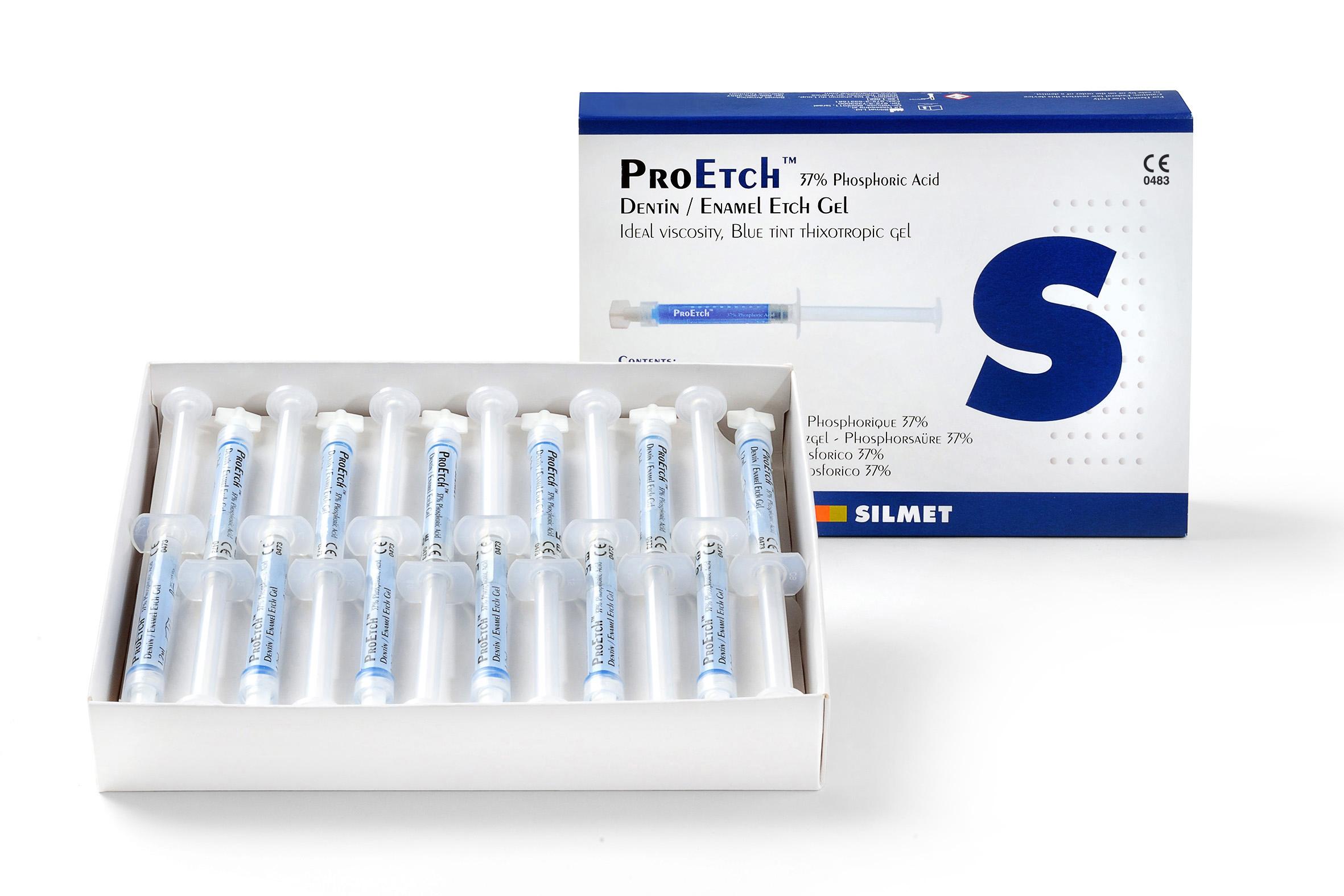
Selective enamel etch applies phosphoric acid to unprepared or peripheral enamel only, then proceeds with the self-etch step of the adhesive on dentin. This approach tends to produce a more reliably sealed enamel margin than self-etch alone, since phosphoric acid creates a deeper, more retentive etch pattern on enamel than the mild acidity of most universal adhesives typically achieves. It is a common choice for anterior restorations and any margin where enamel integrity is a priority.
Total-etch, or etch-and-rinse, applies phosphoric acid to both enamel and dentin before the adhesive step. It produces the deepest enamel etch pattern but carries a higher risk of dentin overetching, collagen collapse, and postoperative sensitivity if moisture control is not managed carefully. It remains appropriate where enamel bonding quality is the priority and the operator can control dentin moisture precisely, such as veneer preparations with substantial enamel remaining.
The right approach depends on how much enamel and dentin are present at the margin, the restoration type, and how much control the clinical setting allows over moisture during bonding.
Enamel and dentin bond through different mechanisms, and long-term strength depends on satisfying both. Enamel bonding relies primarily on micromechanical retention from the etch pattern, so etch depth and surface cleanliness matter most. Dentin bonding depends more on hybrid layer formation and, with MDP-containing adhesives, chemical bonding to calcium in the smear layer and hydroxyapatite, so moisture content and smear layer condition matter more than etch depth alone.
Moisture control affects dentin bonding directly. Overdried dentin causes collagen fibers to collapse, blocking resin infiltration into the collagen network and reducing bond strength even when adhesive is reapplied. Overwet dentin dilutes the adhesive and leaves residual water trapped in the hybrid layer, which weakens the bond over time and can contribute to hydrolytic degradation. A moisture-tolerant formulation reduces the sensitivity of the outcome to small variations in dentin wetness, but it does not eliminate the need for a controlled, slightly moist surface at the point of application.
Surface preparation, including removal of old restorative material, caries, and contamination from saliva or blood, determines whether the adhesive is bonding to sound tooth structure or to debris. Any residual contamination sits between the adhesive and the substrate and can become the weakest point in the bond.
Operator technique is a major contributor to the variability seen between otherwise identical adhesive applications. Active scrubbing of the adhesive into the surface for the manufacturer-specified time, complete solvent evaporation before curing, and full curing time appropriate to the light source and mode all affect the polymer network that forms. Skipping or shortening any of these steps can produce a bond that passes initial testing but underperforms over months of function.
The most frequent bonding failures stem from a small set of repeatable mistakes. Inadequate solvent evaporation leaves residual ethanol or water in the adhesive layer, which weakens polymerization and increases the risk of a soft, incompletely cured bond. Insufficient curing time relative to the light source, particularly with lower-output curing units, produces a similar result even when the adhesive itself was applied correctly. Etching enamel and dentin identically in a total-etch protocol, without adjusting for dentin's higher acid sensitivity, is another common cause of postoperative sensitivity and marginal breakdown.
Contamination during application, including saliva exposure between etching and bonding or blood contamination at the margin, compromises the bond regardless of adhesive quality and usually requires re-etching and reapplication rather than simply adding another coat.
Adjustments that reduce these failures are procedural rather than material-based: isolating the field adequately before starting the bonding sequence, following the manufacturer's stated application and cure times rather than a generalized routine, and verifying that the curing light's output is adequate for the material and layer thickness in use. A universal bond that tolerates moisture variation and applies in a single step reduces some of these risks, but it does not remove the need for a consistent, verified protocol.
A well-formulated universal adhesive should reduce the number of separate products and steps a practice needs to stock and manage, without narrowing the range of cases for which it can be used. In practice, that means one bottle that moves between direct composite restorations, indirect cementation, and composite repair, compatible with the etching strategy chosen for each case rather than locked into one protocol.
We formulated ProLink Universal to meet that need. It combines etching, priming, and bonding in a single bottle, and it is formulated to support self-etch, selective-etch, and total-etch protocols so the etching decision stays with the clinician rather than the material. It contains MDP and 4-MET for chemical adhesion to calcium in the tooth structure, in addition to the micromechanical bond formed through the etch pattern. Its formulation is designed to tolerate variation in dentin moisture and humidity, which is relevant in deep dentin cases where achieving a consistently moist surface is harder to control. It also bonds to self-cure and dual-cure composites and resin cements without requiring a separate activator, which simplifies indirect cementation workflows where an activator step is often forgotten or applied inconsistently. Shear bond strength is documented above 10 MPa in manufacturer testing, with a film thickness under 10 microns and curing time of 5 to 20 seconds depending on the light source used.
For a practice standardizing its bonding protocol, that combination means fewer materials to keep in inventory and fewer decision points where technique error can be introduced, while still leaving the etching strategy open to clinical judgment case by case.
Yes, provided the adhesive is formulated to bond to both light-cure and chemically cured materials. ProLink Universal is formulated for direct and indirect restoratives and bonds to self-cure and dual-cure composites and resin cements without requiring a separate activator, which is what makes single-bottle use across both restoration types practical rather than only theoretical.
Not in every case. Selective enamel etching improves the enamel margin seal compared with self-etch alone, so it is generally preferred where unprepared or peripheral enamel is present, such as anterior restorations or wide Class II margins. Where enamel is minimal or already beveled and dentin makes up most of the preparation, a self-etch approach alone is often sufficient and lowers the risk of dentin overetching.
Most failures stem from application technique rather than the adhesive itself, most often incomplete solvent evaporation before curing, insufficient curing time for the light source in use, or contamination of the surface between etching and bonding. Correcting these procedural steps resolves the majority of bonding failures seen with universal adhesive systems.